
Smart contracts are changing how retailers manage transactions, supply chains, and customer relationships. These self-executing agreements run on blockchain technology and carry out their own terms the moment agreed conditions are met, removing manual steps from processes that have traditionally relied on paperwork, reconciliation, and back-office checks. The law firm Bird & Bird describes a smart contract as “a way for a legal contract to be executed automatically without human intervention” — and it is exactly that automation that makes the technology so relevant to retail.
Here is a practical look at how smart contracts work in a retail setting, where they deliver the most value, what market research says about the technology’s growth, and what to weigh before bringing them into your own operations.
How Smart Contracts Work in Retail
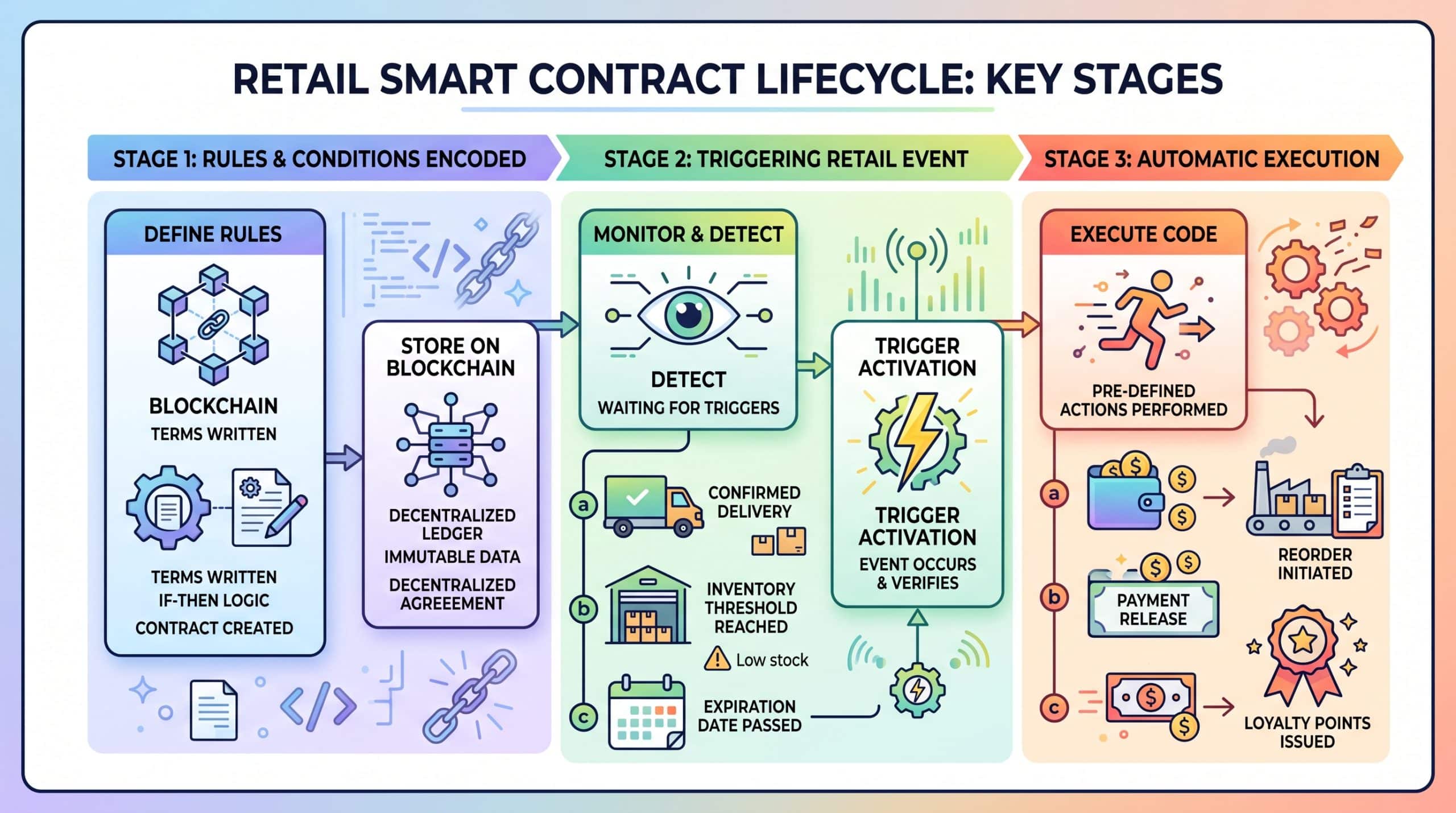
A smart contract is a set of predefined rules and conditions encoded on a blockchain. When those conditions are met, the contract executes automatically — no invoices to chase, no manual sign-offs, and no intermediary needed to confirm that both sides held up their end of the agreement. In retail, that pattern maps naturally onto everyday operations:
- Automated payments: funds are released to a supplier as soon as a delivery is confirmed.
- Authenticity checks: product authenticity can be verified instantly against records stored on the blockchain.
- Inventory triggers: stock is reordered automatically when inventory falls to a set level.
- Loyalty rewards: points are distributed seamlessly based on customer actions, with no manual processing.
Because execution is automatic and the underlying records are tamper-resistant, retailers and their partners can trust the outcome without auditing every step themselves.
Key Benefits of Smart Contracts in Retail
- Enhanced security: automated, tamper-proof transactions reduce the risk of fraud, because no party can quietly alter the terms or the record of what happened.
- Improved efficiency: streamlined processes save time and reduce costs by removing repetitive administrative work from routine transactions.
- Supply chain transparency: better tracking of product origins and movements gives retailers a clearer picture of where goods come from and where they are at any moment.
- Customer loyalty: reward programs run automatically and transparently, so customers can see exactly how and when they earn their benefits.
- Reduced errors: minimizing manual intervention in contract execution means fewer data-entry mistakes, missed payments, and disputed invoices.
Taken together, these benefits change the character of retail agreements: instead of trusting counterparties to follow through and checking afterwards whether they did, the follow-through is built into the contract itself.
How Big Is the Smart Contracts Market?
Estimates of the smart contracts market’s size and trajectory vary from firm to firm:
- Mordor Intelligence expects the market to grow from USD 2.6 billion in 2025 to USD 3.12 billion in 2026, and to reach USD 7.73 billion by 2031 at a 19.92% compound annual growth rate (CAGR) over 2026–2031.
- Fortune Business Insights valued the global market at USD 2.69 billion in 2025 and projects growth from USD 3.39 billion in 2026 to USD 16.31 billion by 2034, at a 26.30% CAGR.
- Market.us puts the market at USD 1.9 billion in 2024 and expects it to reach USD 14.9 billion by 2033, at a 25.8% CAGR from 2024 to 2033.
- Precedence Research sizes the market at USD 3.69 billion in 2025, projects USD 6.71 billion in 2026, and forecasts as much as USD 1,073.24 billion by 2035 at a 76.25% CAGR from 2026 to 2035.
The figures differ because each firm publishes its own estimate, but every one of these projections points the same direction: sustained growth in the use of smart contracts.
Retail Use Cases in Practice
Market.us reports that retail businesses are turning to smart contracts for supply chain transparency, inventory management, and automated transactions. IMARC Group likewise identifies retail as one of the application areas in its smart contracts market report.
On the supply-chain side, Aptos describes one retail use case as a smart contract governing the sourcing, manufacturing, and delivery of goods. Combined with the payment, authenticity, inventory, and loyalty scenarios described above, this shows how far the technology can reach across a retail operation.
Challenges and Considerations
Smart contracts offer significant benefits, but retailers should go in with a clear view of the difficulties:
- Integration complexity: aligning smart contracts with existing systems can be challenging, and most retailers already run a substantial stack of established software.
- Regulatory compliance: contracts must meet legal requirements across every jurisdiction in which a retailer operates, and those requirements continue to evolve.
- Security vulnerabilities: smart contracts are not immune to coding errors or exploits, and because execution is automatic, a flaw can act before anyone catches it.
- Scalability: handling high transaction volumes efficiently remains a real constraint for retail-scale deployments.
None of these challenges is a reason to avoid the technology, but each is a reason to plan deployments carefully rather than rushing them into production.
Future Trends in Retail Smart Contracts
The outlook for smart contracts in retail is promising, with several trends shaping where the technology goes next:
- Enhanced supply chain visibility and traceability
- Integration with IoT for real-time inventory management
- Automated compliance and auditing processes
- Personalized, blockchain-based loyalty programs
- Seamless omnichannel experiences powered by smart contracts
Implementing Smart Contracts in Your Retail Business
To leverage smart contracts effectively:
- Identify processes that could benefit from automation and increased transparency — supply chain management, payment processing, and loyalty programs are natural starting points.
- Partner with blockchain and smart contract experts to develop solutions tailored to your operation rather than adopting a generic template.
- Ensure proper security measures and thorough testing before deployment, since automatic execution leaves little room for catching mistakes after the fact.
- Train staff on the new systems and processes so the technology supports the way your teams actually work.
- Stay informed about regulatory developments in blockchain and smart contracts in every market you serve.
Start with small-scale pilots to test and refine your approach before wider implementation. A pilot limited to a single supplier relationship or a single loyalty mechanic lets you learn the technology’s quirks without putting core operations at risk.
Conclusion
Smart contracts have the potential to significantly transform retail operations, offering enhanced security, efficiency, and better customer experiences. Challenges exist — integration, regulation, security, and scale all demand attention — but embracing the technology thoughtfully can provide a competitive edge in an evolving retail landscape.
Begin by evaluating your current retail processes to identify opportunities for smart contract integration, focusing on the areas where automation and transparency would add the most value. Then consult with blockchain experts to explore how the technology can enhance your operations and your customers’ experience.