
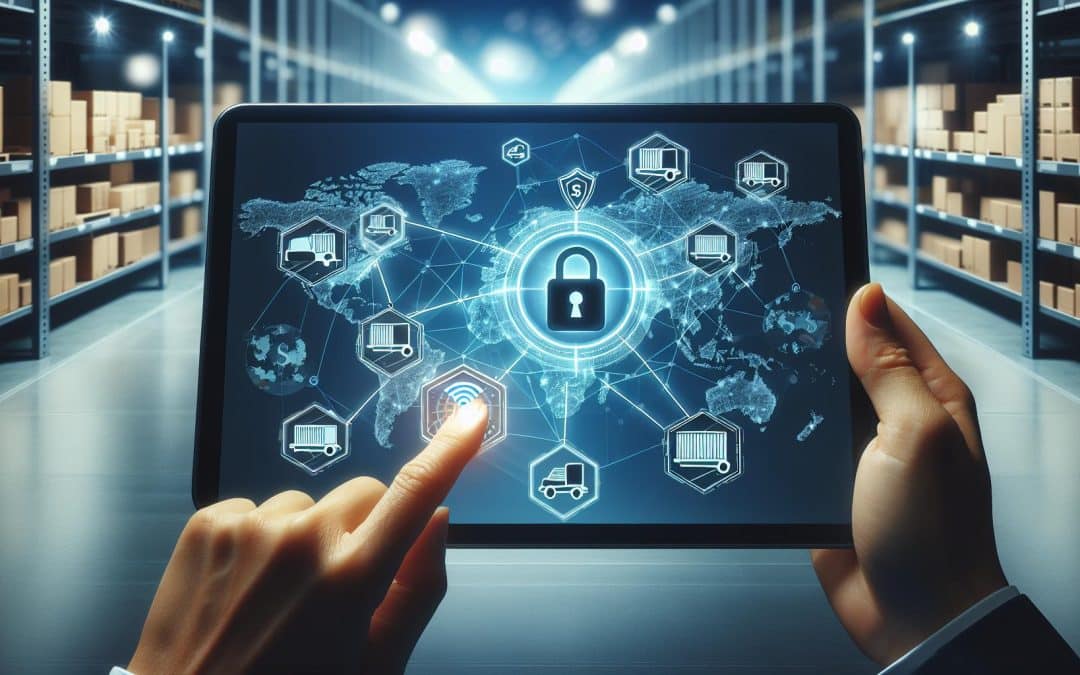
Blockchain technology is transforming retail logistics, promising enhanced transparency, security, and efficiency across the supply chain. This guide covers what the underlying technology is, the benefits retailers pursue with it, where it is applied inside supply chain operations, and what published research and industry documentation say about its use.
What blockchain actually is
Before looking at retail use cases, it helps to be precise about the technology itself. IBM describes blockchain as a shared, immutable digital ledger that enables the recording of transactions and the tracking of assets within a business network. Investopedia describes it as a decentralized digital database or ledger that securely stores records across a network of computers in a way that is transparent and immutable. Deloitte describes blockchain as a record of transaction data that relies on a shared ledger, and describes that ledger as inherently tamper-evident and as providing a trusted, shared and reliable record.
Those descriptions converge on the same basic idea. Rather than each party in a chain keeping only its own private record, participants share a ledger across a network, entries are recorded rather than quietly revised, and the record is available to the parties on that network. That arrangement is the foundation for the retail use cases below.
It is worth noting that blockchain is not a single fixed design. A technical and legal introduction published by Richmond JOLT explains how blockchain technology works and can be deployed in various ways to create applications with different features, including open, distributed and centralised ledgers. The deployment model is a design decision, not a given.
Key benefits of blockchain in retail logistics
The benefits retailers are chasing fall into a short list, and each one maps to a specific property of a shared ledger.
Enhanced transparency
Enhanced transparency means real-time tracking of products from manufacturer to store shelves. Instead of visibility appearing only at the points where a single business happens to keep records, the intent is a view of product movement that runs the length of the chain. SEKO Logistics states that blockchain technology enhances supply chain transparency, reduces fraud, and improves efficiency in logistics.
Improved security
A decentralized ledger system is used to support authenticity and trust in the records that the chain depends on. This is the same tamper-evident property Deloitte points to: the value is not only that the data exists, but that participants can rely on it not having been quietly altered after the fact.
Streamlined processes
Reduced paperwork and automated agreements through smart contracts are a recurring goal. Documentation is a large part of the work in logistics, and a DHL report on blockchain in logistics notes that Accenture is developing a blockchain-based system focused on replacing the traditional bill of lading as well as facilitating a single source of truth.
Cost savings
The cost case rests on the elimination of intermediaries and on reduced errors. Fewer reconciliations between separately maintained records, and fewer disputes about which version is correct, are the practical form this takes.
Fraud prevention
Immutable records and secure transactions are the mechanism cited for fraud prevention. Where a record cannot be silently rewritten, the opportunities to misrepresent what moved, when, and from where are narrower.
How the product journey is recorded
It is easier to understand the retail use cases by picturing a single item moving through the chain. At each handover, from manufacturer to shipment to distribution to the store shelf, an entry is written to the shared ledger. The result is the detailed product journey information that retailers can then pass on to consumers, and the kind of single source of truth that both industry reports and academic work describe as the goal. Research published via NIH’s PMC investigates open information transactions, their implications on different sectors, and the use of blockchain to provide a single source of truth.
Implementing blockchain in retail supply chains
Retailers are leveraging blockchain to optimize their supply chain management across several distinct applications.
- Inventory tracking: real-time visibility into stock levels and movement, rather than a picture assembled after the fact from separate systems.
- Product authentication: verifying the origin and authenticity of goods, which is the use case most closely tied to counterfeit and provenance concerns.
- Smart contracts: automating agreements and payments between parties, so that a condition being met in the chain can trigger the corresponding commercial step.
- Logistics optimization: improving shipping routes and reducing delays.
- Customer transparency: providing detailed product journey information to consumers.
These map closely to how vendors frame the opportunity. Oracle describes blockchain’s role in reshaping supply chains as enhancing traceability, bolstering transaction verification, and speeding payments — traceability for the tracking and authentication cases, verification and payment speed for the smart contract cases.
Case studies: blockchain in retail
Several major retailers are named in connection with blockchain in retail supply chains:
- Walmart: improved food traceability and safety.
- Carrefour: enhanced product authenticity verification.
- Alibaba: streamlined cross-border logistics and reduced fraud.
Each of these sits in a different part of the benefit list — food safety is a traceability problem, authenticity verification is a provenance problem, and cross-border logistics is a documentation and fraud problem — which is a useful reminder that “blockchain in retail” is not one project but several.
What the research and industry reports say
The body of published work on this subject is substantial, and reading it is the fastest way to separate the demonstrated from the aspirational. A review published by MDPI systematically examines existing blockchain-based supply chain solutions and classifies them based on their structural models. Work published in ScienceDirect identifies the salient elements of the link between blockchain technology and supply chain relationships, and explores them empirically to understand the impact of adoption.
The through-line across these sources is that the technology’s contribution is to the record, and to who can see and trust that record. The operational benefits follow from what an organisation does with a more reliable shared record.
Future trends in blockchain retail logistics
Looking ahead, the commonly anticipated directions are:
- Integration with IoT devices for enhanced tracking.
- Increased adoption of cryptocurrency payments.
- Development of industry-wide blockchain standards.
- AI-powered predictive analytics for supply chain optimization.
These are expectations rather than settled outcomes, and the standards item is the one that most directly affects the others: shared records deliver most when the parties in a chain record things the same way.
Questions to ask before you start
A blockchain project in retail logistics is easier to scope when the questions come before the technology choice.
- Which handovers in your chain do you actually lack visibility into today?
- Which partners would need to write to a shared ledger for the record to be useful, and are they willing to?
- Is the objective traceability, product authentication, faster payment, or a combination — and which one justifies the work on its own?
- Does the use case call for an open, distributed or centralised ledger design?
- What would you measure to know whether transparency, error rates, or delays had improved?
Conclusion
Blockchain is being applied in retail logistics with the aim of improving transparency, security, and efficiency across the supply chain. The recurring theme across vendor documentation, industry reports and academic reviews is a shared, tamper-evident record that replaces a patchwork of private ones — and the retail benefits, from traceability to fraud prevention to faster settlement, are built on top of that record.
Call to Action: If you are a retailer looking to optimize your supply chain, consider exploring blockchain solutions to stay competitive in the evolving retail landscape.